
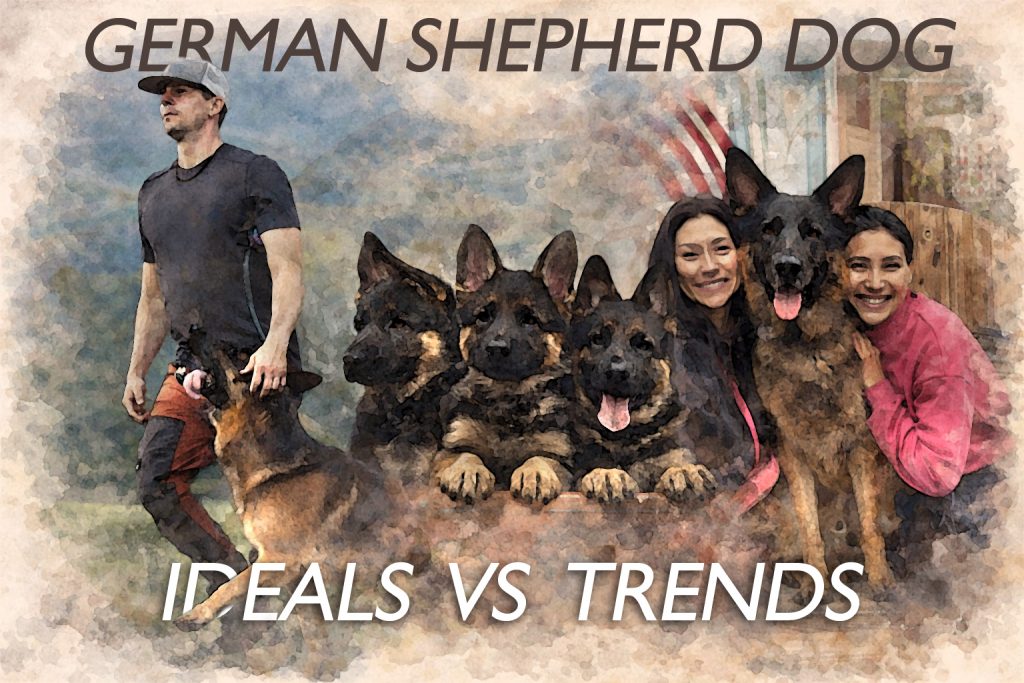
By Abhai Kaul · VAGSD.com
In every era of the German Shepherd, there is a new trend: often loud, often short-lived, often pushed hardest by those who understand the breed the least. Today’s version is the rise of poorly researched working- show crosses, advertised with cinematic imagery and overconfident slogans promising “balance,” “versatility,” and “the best of both worlds.”
Let’s be clear: There is nothing inherently wrong with crossing working and show lines. Some of the most correct German Shepherds ever bred were the result of thoughtful, intentional combinations of complementary lines. Heck, some of the nicer dogs around today come from these type of breedings.
The issue is not the crossing. The issue is the carelessness.
The issue is breeders who lack the knowledge, the lineage depth, and the long-term selection goals to make these pairings responsibly, and instead hide their lack of substance behind dramatic backdrops and buzzwords.
This article is a warning about that specific type of breeding that after seeing the 4th ad for one in one day, triggered me to write this.
Why Purpose Matters More Than Trend
The German Shepherd is a purpose-built breed. Everything in the breed standard, from the forehand assembly to the topline and movement mechanics to the required temperament, exists because structure and character were designed to serve function.
A correct breeding, whether linebred, outbred, or a thoughtful line-combination, depends on:
• Matching temperament profiles
• Matching structural strengths and compensating weaknesses
• Understanding inherited tendencies in both parents’ families
• A track record of consistency of breeding a motherline
• Clear selection goals that align with the breed’s purpose
When those fundamentals are absent, the “best of both worlds” marketing claim becomes a mask for “we have no idea what we’re doing.”
This is how unsuspecting families end up with dogs that are neither structurally sound enough for conformation nor mentally stable enough for work, nor predictable enough for family life.
The Problem With “Aesthetic Pairings” Masquerading as Genetics
Many of these ads feature two dogs that, if we are honest, are not good representatives of their own categories. A working-line dog with questionable nerve, no substance, no discernible physical attributes and/or a show-line dog lacking correct anatomy, expression or movement, is not magically improved by pairing it with something equally mediocre from another lineage.
Two weaknesses do not cancel each other out. They compound.
When the pairing is chosen because:
• the colors contrast nicely,
• the marketing angle feels catchy,
• or the breeder wants to capitalize on a trend,…then genetics becomes an afterthought rather than the foundation. You cannot breed toward balance when you do not start with balance. You cannot promise versatility when neither parent exhibits it. You cannot sell predictability when you have no track record.
The Role of Lineage: Why Depth Matters
Responsible breeding is not a snapshot; it is a story told across generations. When you look at any serious breeding program, whether oriented toward structure, working ability, or a carefully balanced blend, you see certain hallmarks:
1. Multi-generational continuity
Traits do not appear by luck. They repeat because the breeder has selected for them deliberately over time.
2. Defined temperament architecture
Reliable nerve strength, environmental stability, and clarity under stress do not emerge from random pairings.
3. Structural predictability
Correct withers, strong backs, firm ligaments, proper forehand, correct croup lay—these features come from evaluative consistency, not chance.
4. Proven production
A breeder with a track record can show dogs produced in prior generations that consistently embody the program’s goals.
5. Line knowledge
A breeder must understand the family behind the dog, not just the dog in the photograph.
Without this lineage literacy, breeders cannot predict outcomes, and when they cannot predict outcomes, they compensate with marketing as a ploy to sell pups that were born and bred without reason.
Why Poorly Planned Working-Show Crosses Are Especially Unstable
Again, the issue is not the combination of lines. Thoughtful line combinations can produce exceptional dogs. The issue is that working and show lines diverged because breeders selected for different priorities, and combining them requires mastery, not enthusiasm.
A successful working and show cross requires:
• complementary temperaments (not conflicting ones),
• structural compatibility (not compounding faults),
• balanced drive expression,
• matching thresholds and nerve sets,
• and a breeder who genuinely understands both sides of the pedigree.
When these elements are ignored, the result is not “versatility”, it is unpredictability.
The Marketing Red Flags Buyers Should Watch For
To protect the breed, and the unsuspecting public, we must call out the classic linguistic tricks used in these ads:
• “Balanced family protector”
• “Dual-purpose excellence”
• “Ultimate companion and guardian”
• “Best of both worlds”
• “Working dog drive with show dog elegance”
• “Perfect for every lifestyle”
None of these phrases mean anything without supporting evidence: Temperament testing, performance documentation, multi-generation health depth, and actual examples of adult progeny. If the breeder can’t show you proof, they will show you production value: big fonts, dramatic landscapes, and bold claims.
When the ad grows louder, the genetics grow thinner.
What Responsible Buyers Should Look For
To protect your family, your investment, and the breed itself, prioritize breeders who offer: Pedigree transparency, Clear structural reasoning behind the pairing, Evidence of consistency in prior litters, Clear selection philosophy (not a trend), Lineage depth and knowledge, The ability to articulate why this sire to this dam makes sense
Great dogs are not created in marketing jargon. They are created in a breeding program.
Conclusion: The German Shepherd Is Too Important To Be Trend Chased
Our breed is more than a silhouette on a mountain background. It is a legacy of service, structure, intelligence, and partnership. When breeders abandon lineage, temperament, and structure in favor of trends and taglines, the breed loses: not in theory, but in the lives of families left with unstable, unhealthy, or unmanageable dogs.
Working–show crosses can be brilliant. But brilliance requires intentionality, not hype, novelty nor empty promises.
As stewards of the German Shepherd Dog, it is our responsibility to insist on standards, depth, and purpose, because no gimmick has ever protected a flock, served a handler, or enriched a family, Only good breeding has.
Responsible German Shepherd breeding practices
Correct anatomical structure, especially the forehand
The essence of the German Shepherd beyond trends
Evaluating Breed specific heeling in the German Shepherd