
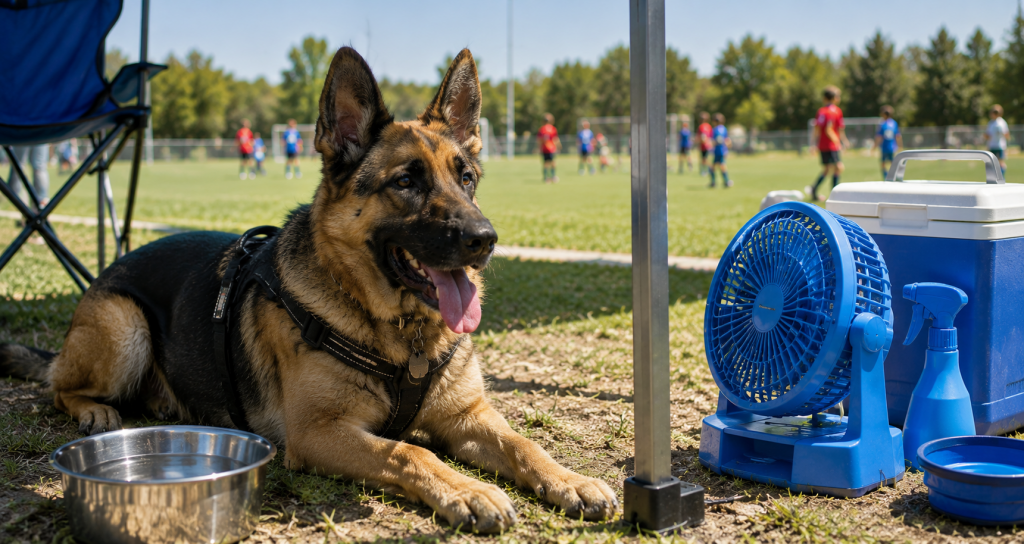
Most dog owners know not to leave a dog in a hot car. Far fewer realize that heat stroke often happens at soccer games, hiking trails, dog shows, campgrounds, training fields, and even outdoor restaurants.
Heat stroke is one of the most dangerous emergencies a dog can experience. It can develop quickly, progress rapidly, and become life-threatening in a matter of minutes.
The good news is that heat stroke is almost always preventable.
Whether you own a family pet, compete in dog sports, travel with your dog, or simply enjoy spending time outdoors together, understanding heat stress could save your dog’s life.
Quick Answer: How Can I Prevent Heat Stroke in My Dog?
Heat stroke occurs when a dog’s body temperature rises faster than it can cool itself through panting. Prevention includes providing shade, water, airflow, rest periods, and monitoring for signs of heat stress such as excessive panting, dark red gums, thick saliva, weakness, or disorientation. Dogs can overheat during hikes, sporting events, dog shows, camping trips, road trips, and outdoor activities—even when temperatures seem moderate.
Why Dogs Overheat Faster Than Humans
Humans cool themselves primarily through sweating. Dogs do not.
Dogs rely mainly on:
- Panting
- Limited sweat glands in their paw pads
- Heat exchange through blood vessels in the face and ears
When environmental heat, humidity, excitement, or physical exertion exceed a dog’s ability to dissipate heat, body temperature begins to rise.
Once a dog’s internal temperature reaches dangerous levels, organ systems begin to suffer damage.
Heat stroke is not simply “being hot.” It is a medical emergency.
What Is Heat Stroke in Dogs?
Heat stroke occurs when a dog’s body temperature rises to dangerous levels and normal cooling mechanisms can no longer keep up.
Unlike dehydration, which develops over time, heat stroke can escalate rapidly. Without immediate intervention, heat stroke can lead to:
- Organ failure
- Blood clotting abnormalities
- Neurological damage
- Kidney failure
- Death
According to guidance from the American Veterinary Medical Association and the American Kennel Club, heat stroke should always be treated as an emergency requiring prompt veterinary attention.
Hidden Places Dogs Develop Heat Stress
Most people immediately think of parked vehicles. In reality, many heat stroke cases occur in places that seem perfectly safe.
The Kid’s Soccer Game
This is one of the most common and overlooked situations.
The dog is:
- Under a canopy
- Drinking water
- Sitting quietly
- Not exercising
Everything appears fine, yet the dog may spend four or five hours accumulating heat; Factors include:
- Limited airflow
- Reflected heat from fields
- Excitement and stimulation
- Long periods without true cooling
Many owners never realize the danger until symptoms appear.
Outdoor Restaurants and Breweries
Dogs have become welcome companions at many outdoor dining spaces. Unfortunately, these locations often combine several risk factors:
- Concrete surfaces
- Reflected radiant heat
- Limited airflow
- Direct sun exposure
- Crowded conditions
A dog quietly lying under a table may actually be getting progressively hotter.
Hiking Trails
Many owners assume hiking automatically means cooler temperatures. Unfortunately, hiking presents unique risks.
Common Hiking Mistakes
Starting Too Late
A comfortable morning can quickly become dangerous by midday.
Underestimating Humidity
Humidity often matters more than temperature, panting becomes far less effective in humid conditions.
Overestimating Fitness
Conditioned dogs tolerate heat better but they do not become immune to it.
Ignoring Surface Temperatures
Rock faces, dirt trails, and exposed terrain frequently reach temperatures far above the surrounding air.
Campgrounds and RV Parks
Camping creates prolonged environmental exposure. Risk factors include:
- High humidity
- Limited airflow
- Warm nighttime temperatures
- Increased activity levels
- Multiple consecutive days outdoors
Heat stress can accumulate over several days.
Road Trips and Travel Days
One of the least recognized dangers occurs during travel. The vehicle may be comfortably air-conditioned.
Then:
- Traffic stops
- Fuel breaks happen
- Lunch takes longer than expected
- Mechanical issues arise
Suddenly airflow decreases while temperatures rise rapidly inside crates and vehicles. Travel-related heat emergencies occur more often than many owners realize.
Dog Shows, Sporting Events, and Working Dogs
Owners involved in canine sports should pay particular attention.
Dog Shows and Conformation Events
Many handlers become focused on preparing for the ring and overlook cumulative heat exposure throughout the day. Risk factors include:
- Grooming tents
- Blacktop parking lots
- Limited airflow
- Long periods in crates
- Elevated stress levels
Even mild temperatures can become problematic over an entire day.
IGP, Protection Work, and Bitework
This is one of the most obvious heat-risk activities. High-drive dogs often push themselves beyond safe physical limits. Many working dogs will continue training long after they should stop. Risk factors include:
- Repetitive exercises
- High arousal levels
- Long waits between sessions
- Dark pigmentation
- Protective equipment
- Elevated drive states
The dog’s willingness to continue should never be mistaken for safety.
Handler Rule
If you’re wondering whether your dog needs a break, the answer is probably yes.
Agility, Flyball, Dock Diving, and Disc Sports
Fast, explosive sports create tremendous internal heat, while many dogs appear fine immediately after competition, problems often develop during recovery. This is why post-exercise monitoring is just as important as monitoring during activity.
Are Some Dogs More Susceptible?
Yes. Higher-risk groups include:
- Puppies
- Senior dogs
- Overweight dogs
- Dogs with cardiac disease
- Long-coated dogs
- Dark-colored dogs
- Brachycephalic breeds
The German Shepherd Dog generally tolerates heat better than many breeds. However, working-line German Shepherds present a unique challenge. Many are highly driven and often ignore fatigue, discomfort, and overheating. This makes handler awareness even more important.
Early Signs of Heat Stress in Dogs
Recognizing heat stress before it becomes heat stroke is the single most important skill a dog owner can develop.
What Are the First Signs of Heat Stroke in Dogs?
Early warning signs include:
- Excessive panting
- Bright red gums
- Thick saliva
- Slowing down
- Seeking shade
- Reduced enthusiasm
- Delayed responses
- Difficulty recovering after exercise
Recognizing these symptoms early can prevent a life-threatening emergency.
Signs of Heat Stroke in Dogs
Heat stroke requires immediate veterinary attention.
Symptoms may include:
- Collapse
- Vomiting
- Diarrhea
- Weakness
- Staggering
- Glassy eyes
- Disorientation
- Loss of coordination
- Seizures
- Unresponsiveness
At this stage, every minute matters.
The Three Rules That Prevent Most Heat Emergencies
After decades of traveling, training, showing, and competing with dogs, three principles consistently prevent problems.
Rule #1: Manage Exposure, Not Temperature
Temperature alone is misleading.
Always consider:
- Humidity
- Surface temperature
- Airflow
- Activity level
- Duration of exposure
- Sun intensity
An 80°F humid day can be more dangerous than a dry 95°F day.
Rule #2: Carry Cooling Equipment Everywhere
Whether attending a youth soccer game or a national championship event, basic cooling equipment should always be available.
Essential Cooling Kit
- Fresh water
- Collapsible bowl
- Cooling towel
- Battery-powered fan
- Spray bottle
- Digital thermometer
Preparation prevents emergencies.
Rule #3: Monitor Recovery
Many heat-related emergencies occur after activity ends.
Monitor:
- Breathing rate
- Gum color
- Energy level
- Coordination
- Recovery time
Recovery should be steady and predictable.
If it is not, investigate immediately.
What To Do If Your Dog Is Overheating
Immediate Actions
- Move your dog to shade.
- Stop all physical activity.
- Offer cool drinking water.
- Begin active cooling.
- Contact a veterinarian.
Effective Cooling Areas
Focus on:
- Belly
- Groin
- Armpits
- Feet
Use cool water and airflow to maximize evaporative cooling.
What Not To Do
Avoid:
- Ice baths
- Extremely cold water
- Waiting to see if the dog improves
Even if your dog appears to recover, veterinary evaluation is strongly recommended after significant heat exposure.
Build a Heat Stroke Prevention Kit
Every traveling dog owner should carry:
Hydration
- Water
- Collapsible bowls
- Electrolyte solution approved by your veterinarian
Cooling
- Cooling vest
- Cooling towels
- Battery-powered fan
- Spray bottle
Monitoring
- Digital thermometer
- Emergency veterinary contact list
Travel
- Portable shade canopy
- Reflective emergency blanket
- Vehicle temperature monitor
These items should be considered as essential as a leash.
Frequently Asked Questions
Can dogs get heat stroke in the shade?
Yes. Shade reduces direct sunlight but does not eliminate humidity, poor airflow, radiant heat, or prolonged exposure.
What temperature is too hot for dogs?
There is no universal answer. Humidity, activity level, conditioning, and breed all matter. Many dogs begin experiencing heat stress when temperatures exceed 80°F, especially during exercise.
Can dogs get heat stroke while hiking?
Absolutely. Hiking combines exercise, environmental heat, and limited cooling opportunities, making it a common source of heat-related illness.
Are German Shepherds prone to heat stroke?
German Shepherds generally tolerate heat better than many breeds, but they can absolutely develop heat stroke, particularly during strenuous exercise, travel, dog sports, or prolonged outdoor exposure.
How long does it take for a dog to recover from heat stroke?
Recovery depends on severity. Mild heat stress may resolve quickly, while severe heat stroke can require hospitalization and extensive supportive care.
Final Thoughts
Heat stroke rarely occurs because an owner doesn’t care, it happens because danger often looks harmless.
Whether it is the soccer game, the campground, the hiking trail, the restaurant patio, at the dog show or the training field, the common thread is that dogs often continue long after they should stop. Our responsibility is to recognize the warning signs before they do. When it comes to heat stroke, prevention is always easier than treatment.
About the Author
Abhai Kaul is a lifelong German Shepherd Dog breeder, trainer, competitor, and judge apprentice with more than 25 years of experience traveling, training, and competing with working and show dogs throughout North America. Through Von Nummer-Eins German Shepherd Dogs, he advocates for the Total German Shepherd Dog, emphasizing health, temperament, working ability, and practical canine management.
Keywords:
heat stroke prevention in dogs, dog heat stroke, dog overheating symptoms, heat exhaustion in dogs, dog summer safety, hiking with dogs in hot weather, dog show safety, IGP training safety, German Shepherd heat tolerance, dog travel safety, canine heat stress, working dog summer safety, camping with dogs, dog cooling tips, dog emergency preparedness.