
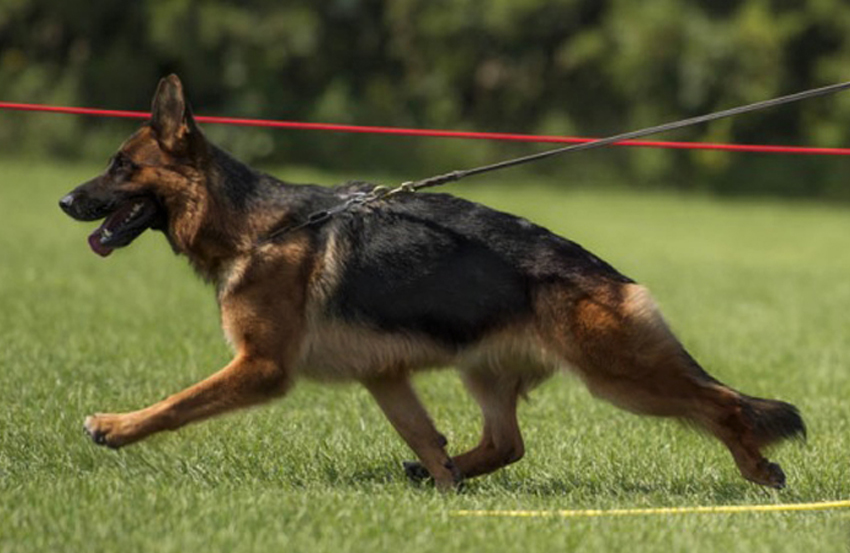
When people fall in love with the German Shepherd, they’re usually first captivated by the outline: that noble head, the proud posture, the unmistakable silhouette. But if you ask breeders, trainers, or anyone who has seen a truly correct dog move… the real magic begins when you see the German Shepherd in motion, as the dog starts trotting.
A proper German Shepherd doesn’t hammer the ground or bounce like a spring; it floats: most amount of ground covered for the least amount of effort spent. In metaphorical terms, you can draw long lines under its body, as if tracing the path of a moving fence gliding through a field.
This article hopes to impart on you, in friendly, simple terms, why that movement happens, and how the forehand, the neck and withers, the balance of proportions, and even the dog’s head all work together to create the iconic German Shepherd gait.
1. The Forehand: The Starting Point of True Reach
Most newcomers focus on the rear. It’s dramatic, powerful, and easy to notice, also being the bone of contention in the breed, giving its iconic stance, but the forehand: the shoulders, the upper arm, and the whole front assembly is what determines how far a dog can reach.
Two bones matter most:
- The scapula (shoulder blade)
- The humerus (upper arm)
Imagine these bones as the handles of a pair of long bicycle pedals. Long pedals = long strokes = long reach. Short ones, much like a BMX bike, You can pedal fast, but you won’t go far.
A German Shepherd with a steep shoulder blade, or a short upper arm will have a choppy front action. The dog lifts its legs higher, not farther. This is the opposite of the breed’s purpose as far as motion is defined.
In the simplest possible terms
A correct forehand is the dog’s “front engine.” If it’s built right, the dog can take long, efficient strides with little effort. If it’s not? The rest of the dog can be perfect and movement will still be wrong.
2. The Neck & Withers: The Dog’s Suspension Bridge
Think of the topline, the line from the neck to the tail like a suspension bridge. The withers are the main support tower, the neck is the lead cable, the back is the bridge deck. If the withers are too flat, too short, or don’t rise clearly from the back, the whole “bridge” weakens. The topline wobbles. The dog simply loses efficiency.
What correct withers do
- Stabilize the topline
- Anchor the shoulders
- Allow the neck to extend forward
- Help absorb impact during the trot
When the dog moves, the neck should “flow” into the withers like watercolor blending: smooth, natural, without a sudden angle. If that connection is abrupt or weak, movement becomes stiff and choppy.
3. Balanced Proportions: Where Movement Lives or Dies
This is the part almost everyone gets wrong. A German Shepherd can have a beautiful head, a powerful rear, and great markings but if the dog is not balanced, movement breaks instantly.
Balance means:
- The front angle matches the rear angle
- The stride length from the front matches the stride length from the rear
- The dog shares work equally between front and back
When one end does more work than the other, the dog has to compensate.
The Most Common Imbalance: Overdone Rear + Weak Forehand
You’ve seen these dogs with Enormous, sweeping rear angulation, steep rounded croups, But the front is often too straight, Too short, with a deep chest cavity, failing to produce sufficient reach.
This mismatch creates what beginners often mistake as “power.” It isn’t power, it’s imbalance.
What it looks like in motion
The dog tips forward, loads the elbows and pasterns, looks downhill, uses the front like a brake (looks like its digging to the other end of the world), and literally as the judges like to say,“lays on the front.” It’s as if the rear wants to draw a long line but the front can only draw a short one, so the dog falls forward with every stride.
Why this matters
The German Shepherd was designed to trot for hours. Imbalanced structure creates fatigue, inefficiency, and wasted energy. A correct dog doesn’t look dramatic. It looks effortless.
4. The Head: The Dog’s Built: In Balancing Pole
The German Shepherd is unique among herding breeds in how it uses its head to maintain rhythm and balance in the trot.
The head acts like a tightrope walker’s pole.
A correct head carriage is: forward-reaching, slightly lowered & aligned with the topline. This helps the dog to lengthen the stride, stay parallel to the ground, maintain steady momentum, keep the topline calm and firm. The old adage used to state that you should be able to balance a beerstein on the back of the dog as its moving without spilling any of its contents.
When the head is too heavy or carried too high, Everything falls apart.
Oversized heads
These may look “impressive,” but biomechanically they act like putting a dumbbell on the end of a fishing rod, rendering the Movement unstable. It also shortens the stride as the dog compensates by lifting the head or choppily adjusting its steps and hence losing stamina quite easily. A far cry from a dog thats supposed to be an all day long worker.
High head carriage
This is often rewarded incorrectly in pet-level show rings. But in reality it raises the withers, shortens the forehand reach, disrupts balance, and breaks the parallel to the ground, iconic “moving fence” silhouette.
A German Shepherd is supposed to move like a working dog, not a prancing Hackney pony.
5. The “Moving Fence”: The Essence of the German Shepherd in motion: the Efficient Gait
When the forehand, topline, proportions, and head balance all work together, the result is unmistakable:
- low, ground-covering stride
- minimal vertical movement
- long lines underneath the body
- rear and front working in perfect tempo
- effortless energy conservation
The dog doesn’t bounce nor stomp, it should not “fly” on exagerated arcs. It simply moves like a fence being pushed smoothly forward: straight, parallel, efficently and level. This movement is the German Shepherd Dog’s signature.
6. How Newcomers Can German Shepherd in motion
GOOD movement is when:
- The dog glides parallel to the ground
- Front and rear reach match
- Topline stays stable
- Head stays forward, not high
- The dog looks comfortable, rhythmic, and efficient
Beware of these red flags:
- Excessive rear angulation
- Short, steep forehand
- Dog falling forward or loading the front
- High head carriage
- Heavy, coarse head disrupting balance
- Front legs lifting high instead of reaching forward
- Rear pushing so much the dog looks off-balance
If the dog looks like it’s constantly catching itself from tipping over? That is not good movement, that is poor proportions and an incorrect forehand.
Conclusion: German Shepherd in motion is the Art of Harmony
The German Shepherd’s beauty doesn’t come from exaggeration, it comes from balance. Correct movement is smooth, quiet, and efficient with workman like stamina.
When the forehand is correct, the neck and withers form a stable bridge, the head balances lightly, and the proportions match front to back, the dog becomes what its founder, Captain von Stephanitz intended: A tireless working dog whose movement is not a performance, but the natural expression of harmonius construction.