

A science-based guide to genetics, development, statistics, and common fallacies
By Abhai Kaul | VAGSD.com
Also See: Removing A3 hips from Breeding: An Oversimplification of a Multifactorial Problem
Introduction: Separating Reputation from Reality
Few breeds are as widely misunderstood as the German Shepherd Dog.
Despite being one of the most versatile, capable, and historically proven working breeds in the world, the German Shepherd is often labeled incorrectly as a “sick breed.” Much of this reputation centers around hip dysplasia (HD).
The truth is more nuanced, more hopeful, and far more scientific.
Hip dysplasia is not unique to the German Shepherd, nor is it evidence of inherent weakness. It is a complex developmental condition influenced by genetics, growth, environment, and management: factors that modern research shows we can meaningfully influence.
This article exists to do one thing clearly: Replace fear with understanding.
What Hip Dysplasia Really Is
Hip dysplasia is best understood as a developmental disorder, not a congenital defect.
Key facts supported by veterinary research:
- Dogs are not born with hip dysplasia
- It develops during growth
- Joint looseness (laxity) precedes arthritis
- Arthritic changes are a secondary outcome, not the disease itself
This distinction is critical and consistently emphasized in the literature (Smith et al., 1997; Mäki et al., 2000; Ginja et al., 2010).
Genetics: Important, but Not Destiny
A Polygenic Condition
All modern studies agree: Hip dysplasia is polygenic and multifactorial.
This simply means:
- Many genes contribute small effects
- There is no single “HD gene”
- Modifier genes influence expression
Heritability estimates for hip dysplasia in German Shepherd Dogs typically range from 20–40%, depending on population and study design:
- Mäki et al. (2000): Finnish German Shepherd population
- Malm et al. (2013): Nordic working breeds
- Ginja et al. (2015): Cross-breed meta-analysis
- Oberbauer et al. (2017): Genomic selection research
More than half of hip dysplasia risk is not genetic. This matters deeply for how we talk about the breed.
Environment: Where the Story Is Actually Written
Modern veterinary consensus recognizes that environmental factors play an equal or greater role than genetics in whether hip dysplasia develops.
Key contributors include:
- Rate of growth
- Excess calories during puppyhood
- Calcium and mineral imbalance
- Body weight during development
- Muscle development and coordination
- Surface traction and footing
- Early repetitive impact
- Micro-trauma to immature joints
Smith et al. (1997) famously demonstrated that controlled feeding alone significantly reduced hip dysplasia expression: even in genetically predisposed dogs.
The 2025 paper “The Complexity of Hip Dysplasia in Dogs” (Wayosi et al.) summarizes this clearly: Genes increase readiness. Environment determines realization.
Why German Shepherd Statistics Are Often Misread
German Shepherd Dogs often appear to have higher reported rates of hip dysplasia than other breeds. This statistic is frequently misunderstood and used to paint the breed unfairly.
Several factors explain this:
1. The Breed Is Screened More Than Almost Any Other
German Shepherds are evaluated at far higher rates than most breeds. More data does not mean worse health: it means greater transparency.
2. The Breed Is Large, Athletic, and Fast-Growing
HD is more common in large, athletic working breeds, not fragile ones.
3. Multiple Evaluation Systems Measure Different Things
Radiographic evaluations across systems assess structure, laxity, or degenerative change: not performance or longevity.
4. Structure ≠ Function
Many dogs with radiographic findings live long, pain-free, athletic lives. Conversely, dogs with “perfect” radiographs can still break down under poor management.
Common Fallacies That Harm the Breed
Fallacy 1: “The German Shepherd is a sick breed”
False. The German Shepherd remains one of the most successful working dogs in history: globally used in police, military, service, sport, and family roles.
Fallacy 2: “Hip dysplasia is purely genetic”
Incorrect. Genetics influence risk, not outcome.
Fallacy 3: “One X-ray defines a dog”
Radiographs are a snapshot in time: not a full health biography.
Fallacy 4: “Stricter exclusion always equals progress”
History shows excessive restriction leads to genetic narrowing, not healthier populations.
Growth Matters More Than Most People Realize
Growth Curve Diagram
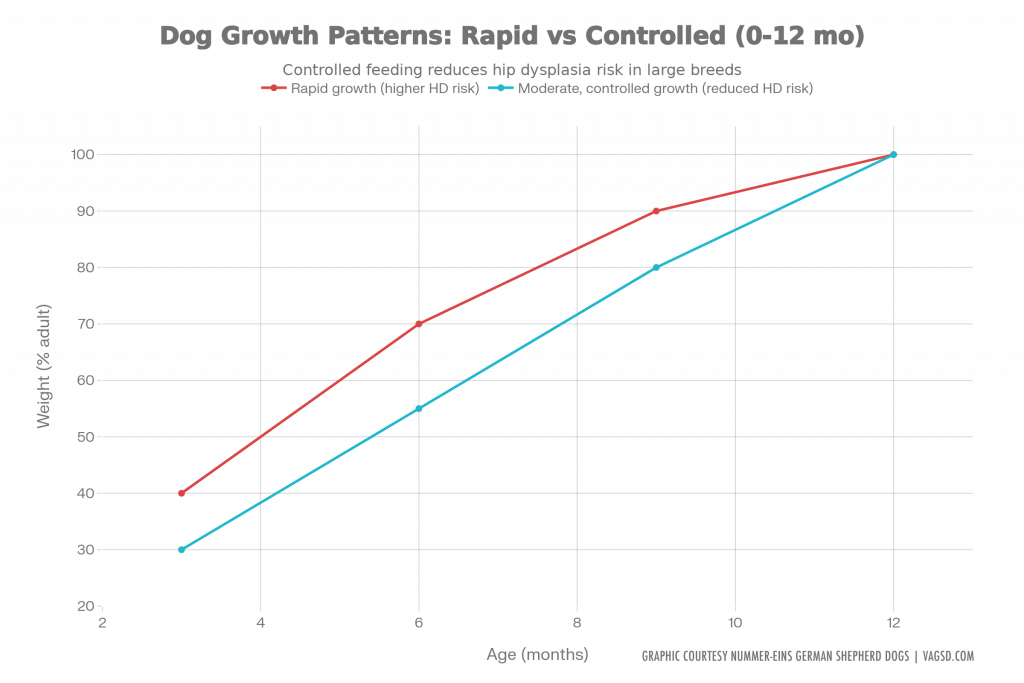
Hip Dysplasia does not begin at birth: It develops during growth. Research shows that rapid early growth places stress on immature joints before muscles and connective tissue can stabilize the hip. German Shepherd puppies raised with moderate, controlled growth develop stronger muscular support, better coordination, and a significantly reduced risk of dysplasia expression. Genetics influence readiness, but growth rate and management determine outcome.
A curve comparing:
- Rapid growth (steep early rise → higher HD risk)
- Moderate, controlled growth (gradual curve → reduced HD expression)
Key takeaway:
Fast growth increases joint stress before muscles can stabilize the hip. Slower, steadier growth allows supportive structures to develop properly.
This principle is well supported in veterinary nutrition and orthopedic research and is one of the most actionable factors for prevention.
What Actually Improves Hip Health in the Breed
The research consistently supports:
- Moderate growth curves
- Lean body condition
- Age-appropriate free movement
- Strength-building over restriction
- Thoughtful breeding decisions
- Educated puppy buyers
- Long-term progeny tracking
Hip dysplasia prevention is active, not passive.
Conclusion: Complexity Is Not a Weakness
The German Shepherd Dog is not fragile. It is not broken. And it is not a failed breed.
Hip dysplasia is a complex developmental condition, shaped by genetics, environment, growth, and management. Reducing that complexity to fear-driven narratives does the breed a disservice.
The path forward is not denial, nor blind restriction, but informed stewardship.
When we understand the science, the German Shepherd stands exactly where it belongs: as one of the most capable dogs ever bred.
Key Scientific References
- Mäki et al., 2000 – Genetic analysis of hip dysplasia in German Shepherd Dogs
- Smith et al., 1997 – Effects of restricted feeding on hip dysplasia development
- Ginja et al., 2010 / 2015 – Canine hip dysplasia: a review and meta-analysis
- Oberbauer et al., 2017 – Genomics of orthopedic disease in dogs
- Malm et al., 2013 – Heritability of HD and ED in working breeds
- Wayosi et al., 2025 – The Complexity of Hip Dysplasia in Dogs